Dessert · American
Almond Fudge Brownies
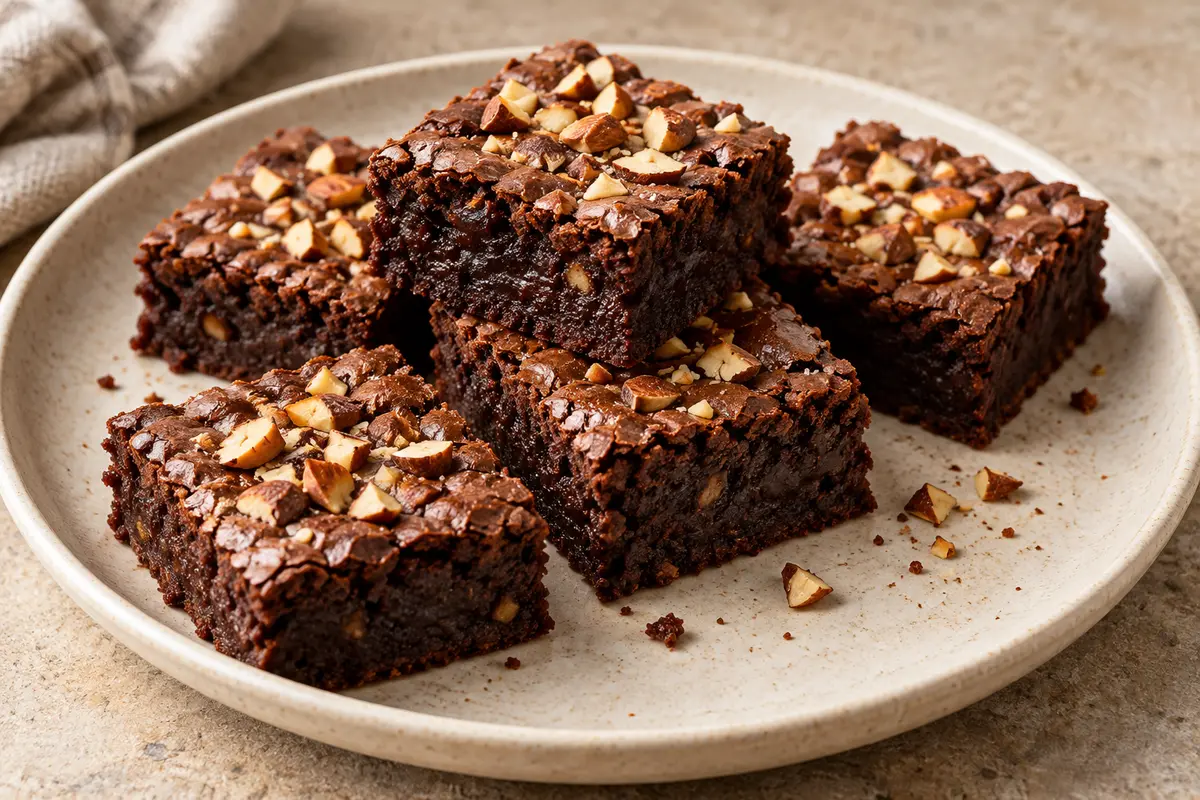
Almond fudge brownies recipe with cocoa, vanilla, a crackly top and toasted nuts, baked in a 27 × 18 cm or equivalent 22 cm square pan.
- Prep
- 20 min
- Cook
- 30 min
- Total
- 50 min
- Serves
- 12 brownie squares
Cook it
Method
Heat the oven to 175°C conventional or 160°C fan. Line a 27 × 18 cm metal baking pan with baking parchment, leaving two overhanging sides for lifting. A pan much larger than this makes thin brownies; a smaller pan needs extra baking time.
Spread the chopped almonds on a small tray and toast them in the heating oven for 5–7 minutes, stirring once, until fragrant and lightly golden. Cool them while making the batter; reserve about 15 g for the top.
Beat the softened butter and sugar in a large bowl for 2–3 minutes until evenly combined and slightly lighter. Beat in the oil and milk; the mixture may look a little separated at this stage, which is normal.
Beat in the eggs one at a time, mixing until the first is incorporated before adding the second. Mix in the almond and vanilla extracts. Scrape the base and sides of the bowl so no butter streaks remain.
Sift the cocoa powder, flour and salt over the wet mixture. Fold just until no dry pockets remain, then fold in 45 g of the toasted almonds. Stop mixing as soon as the batter is uniform so the brownies stay tender rather than cakey.
Spread the thick batter level in the lined pan, pushing it into the corners. Scatter the reserved 15 g toasted almonds evenly over the surface and press them very lightly into the batter so they adhere after baking.
Bake for 28–30 minutes, rotating the pan once after 20 minutes if the oven browns unevenly. The top should look set with fine cracks, the edges should be just pulling from the pan, and a toothpick inserted in the centre should carry moist crumbs but no liquid batter. Check at 26 minutes in a dark metal pan.
Cool in the pan on a rack for 30 minutes, then lift out by the parchment and cool completely for about 60 minutes more. Use a thin sharp knife to cut three rows by four rows for 12 squares, wiping the blade between cuts for clean edges. Cooling time is additional to the 50-minute preparation and baking estimate.
Make it work
Useful substitutions
- For a nut-free version, omit both the almonds and almond extract and increase the vanilla extract to 7.5 ml; check every packaged ingredient for the allergen controls you need.
- A firm dairy-free baking block and unsweetened plant drink can replace the butter and milk by weight and volume. The surface and flavour may differ slightly.
- Natural and Dutch-process cocoa both work because this formula does not rely on baking soda for lift. Use unsweetened cocoa, not sweetened drinking chocolate.
- Margarine can replace the butter at the same weight, as in the source recipe, but choose a full-fat baking margarine rather than a low-fat spread.
Keep it well
Storage and reheating
- Let the brownies cool completely before covering; trapped steam softens the crackly top and makes the cut surfaces sticky.
- For best texture, keep the cut squares in an airtight container at cool room temperature for up to 3 days, separating layers with parchment.
- For longer quality storage, freeze individual squares airtight for up to 2 months. Thaw them wrapped at room temperature so condensation forms on the wrapping rather than the brownie.
Recipe notes
Sources and cooking notes
The pinned Wikibooks source supplies the butter, sugar, oil, milk, egg, cocoa, flour and almond flavouring formula, a 27 × 18 cm pan, 175°C oven and 28–30 minute bake. This adaptation resolves inconsistent volume notation, gives gram weights, uses both extract and chopped almonds, and adds mixing, cooling, doneness, troubleshooting and storage detail.
- Cookbook:Almond Fudge Brownies — Pinned source for the core ingredient formula, oven temperature, pan size, bake time and moist-crumb doneness cue.
- AI Love Food editorial methodology — Normalized quantities and added exact preparation, almond-toasting, cooling, troubleshooting, substitution and storage guidance.
- FDA: Handling Flour Safely—What You Need to Know — Raw flour and raw eggs can carry harmful bacteria; cooking is required and raw batter should not be tasted.
Cooking tips and troubleshooting
Use the stated pan area
The source pan is 10½ × 7 inches, approximately 27 × 18 cm. A 22 cm square metal pan has almost the same base area and is the closest common alternative; begin checking at the same time but expect small thickness differences. A 20 cm square pan is substantially smaller and needs a longer bake.
Moist crumbs mean fudgy, not raw
A clean toothpick usually means the brownies have baked past their fudgiest point. Look for several damp crumbs with no shiny liquid batter, a set top and edges just beginning to pull away.
Cool before judging the centre
The crumb firms as the butter and cocoa mixture cools. Cutting while warm can make a correctly baked centre look underdone and causes ragged edges.
If the batter looks split
Cool room-temperature ingredients reduce separation. If the butter mixture looks curdled after the milk or eggs, continue with the recipe; the sifted dry ingredients normally bring it back together.
Scaling changes the bake, not the pan
The serving calculator scales ingredient quantities only. For a double batch, use two pans rather than one deep pan so the centre and edges bake at the same rate.
Recipe source and licence
Adapted by AI Love Food from Cookbook:Almond Fudge Brownies by Wikibooks contributors (contributor history). This adapted recipe text is available under CC BY-SA 4.0. The image is credited separately.
Adapted from Cookbook:Almond Fudge Brownies. Retains the source’s butter, sugar, oil, milk, egg, cocoa, flour, vanilla and almond formula, 175°C oven, approximately 27 × 18 cm pan and 28–30 minute bake. Normalizes the inconsistent cup/decilitre notation to ingredient weights and millilitres; adds 1.25 ml salt; uses the source’s almond options together as 2.5 ml extract and 60 g chopped toasted almonds; expands nine short directions into eight complete steps with pan lining, mixing order, visual doneness cues, cooling and cutting; and adds troubleshooting, substitutions, storage and raw-batter safety. The adapted recipe text is licensed under CC BY-SA 4.0; the separately generated image is not copied from Wikibooks.